
HSBC Launches RedCoin Stablecoin Wallet in PayMe, Phasing Access Across 3.3 Million Users
Oct. 24, 2026 • Article • Digital Assets
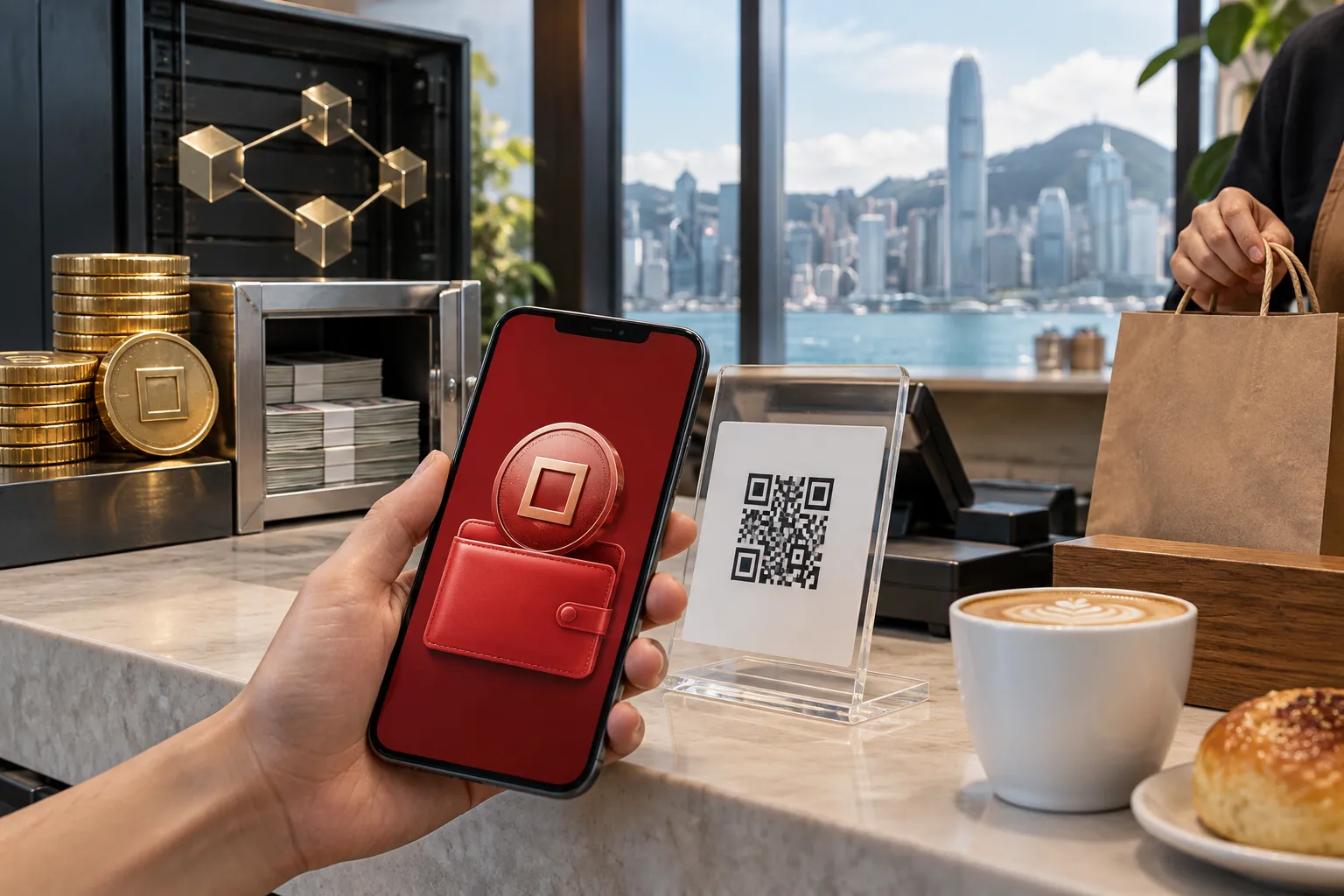
HSBC began a phased rollout of RedCoin wallets through PayMe on October 23, 2026. PayMe has 3.3 million users, but HSBC said wallet access was not available to all of them on launch day. Existing users can activate a wallet without opening a separate bank account or meeting a minimum balance requirement. Merchants that prefer cash receive conventional Hong Kong dollars after an automatic conversion.
RedCoin, or RCHKD, runs on a private, permissioned blockchain whose validator nodes are operated by HSBC. The bank reported approximately HK$80.58 million in circulating tokens and HK$81.58 million in segregated cash reserves at launch. The token is not a bank deposit and is not covered by Hong Kong’s Deposit Protection Scheme. HSBC plans a separate RedCoin wallet in its mobile banking app before the end of 2026 to support tokenized fund investments; direct peer-to-peer transfers between the two apps will not be available.
HSBC began rolling out a RedCoin wallet through its PayMe app on October 23, 2026, bringing a bank-issued Hong Kong dollar stablecoin into a retail payments service with 3.3 million users. Access is being activated in phases over the days following the launch, rather than being available to every PayMe user at once.
The distinction matters because the size of PayMe’s user base describes RedCoin’s potential reach, not the number of people who received a wallet on launch day. Existing PayMe users do not need to open a separate bank account or meet a minimum balance requirement to activate the wallet. For merchants that require cash settlement rather than retaining tokens, RedCoin is automatically converted into conventional Hong Kong dollars before disbursement.
A Phased Retail Rollout
HSBC’s approach places the token inside an existing payments app rather than requiring PayMe users to move to a separate banking product. The rollout nevertheless has a clear access constraint: HSBC clarified that activation across the 3.3 million-user base would take place in phases over several days. Initial reports suggesting that all users had immediate access on October 23 overstated what was available at launch.
The merchant conversion process also sets a boundary on how RedCoin functions in a payment. A PayMe merchant that wants cash receives Hong Kong dollars after conversion, not a token balance it must retain. That arrangement lets the transaction involve a stablecoin without requiring every merchant receiving a payment to hold one. The available information does not establish how many users have activated wallets or how many merchants choose to retain tokens rather than receive cash.
Licensing, Reserves and Consumer Protections
The Hong Kong Monetary Authority granted HSBC stablecoin issuer license FRS02 on April 10, 2026. Anchorpoint Financial received license FRS01 alongside it. The two were selected from 36 applicants under Hong Kong’s Stablecoins Ordinance, which commenced on August 1, 2025. The licensing context is significant to the launch, but it does not make RedCoin the same as a conventional bank account balance.
HSBC’s launch-day disclosure put circulating RedCoin, also known as RCHKD, at approximately HK$80.58 million. It reported approximately HK$81.58 million in segregated cash reserves backing the tokens. The bank manages token custody and safekeeping of the segregated reserve assets internally through HSBC Digital Assets Custody.
Those figures are a launch-day balance disclosure by HSBC, not an independent assessment of the reserves. The first independent third-party reserve attestation report is scheduled for release after the end of the fourth quarter of 2026. Until that report is released, readers should distinguish the bank’s disclosed balances from independently attested figures.
RedCoin is not classified as a bank deposit and is expressly excluded from Hong Kong’s Deposit Protection Scheme. That distinction is relevant even though the issuer is a bank and the reported backing assets are cash. A PayMe user holding RedCoin holds the token under its applicable arrangements, rather than a deposit covered by the scheme.
How the Token and Wallets Work
RedCoin is an ERC-20 token, a token format associated with Ethereum-compatible systems, but it operates on a private, permissioned Hyperledger Besu blockchain. Every validator node on that network is operated directly by HSBC. Validators are the network participants that check and record transactions; in this case, control of that process remains with the bank rather than a broader set of independent operators.
HSBC plans to add a RedCoin wallet to its HSBC HK Mobile Banking app before the end of 2026. The planned integration is intended to enable instant settlement and subscriptions into a new unit class of a Hong Kong dollar money market fund, with a minimum investment threshold of HK$100. That investment use is a future feature, distinct from the current PayMe rollout.
The two wallets will also remain technologically siloed. Users will not be able to make direct peer-to-peer RedCoin transfers between the PayMe wallet and the planned mobile banking wallet. That restriction limits the extent to which the two applications will operate as one connected token network, even as HSBC develops both payments and investment uses for RedCoin.
The next milestones are the completion of phased PayMe wallet activation, the planned mobile banking integration and the first independent reserve attestation. Together, they will provide a clearer picture of how widely RedCoin becomes available, what users can do with it and what independent reserve reporting confirms.

Mastercard and Visa are extending stablecoin technology into the systems that settle card payments between financial institutions, while leaving the consumer checkout experience largely unchanged. Mastercard completed its acquisition of stablecoin infrastructure provider BVNK in August 2026 and has expanded its network’s settlement options to include regulated stablecoins. Visa, meanwhile, is working with Stripe-owned Bridge and Lead Bank on on-chain settlement for card programs. The shift became more concrete in September, when SoFi Bank moved its credit and debit card issuing portfolio to live settlement using its bank-issued SoFiUSD. That portfolio represents more than $25 billion in annualized card volume, a measure distinct from the value settled in stablecoins. Visa separately reported an annualized stablecoin settlement run rate exceeding $25 billion in October. The networks’ initiatives target the back-end movement and reconciliation of funds, including periods when traditional bank settlement rails are unavailable; they do not require merchants to accept cryptocurrency.
The European Central Bank has launched Pontes, a bridge connecting tokenised-asset platforms to the Eurosystem’s TARGET Services for wholesale settlement in central bank money. The arrangement enables atomic delivery-versus-payment settlement, in which an asset and its payment move together. It does not yet make wholesale settlement available around the clock: Pontes depends on T2 operating hours and requires tokenised central bank money balances to be defunded at the end of the day. ECB Executive Board member Piero Cipollone says the Eurosystem plans to extend Pontes operating hours substantially by mid-2027 and reach 24/7/365 availability in 2028. Separately, the Bank for International Settlements’ Project Agorá has tested cross-border payments using a shared programmable ledger that brings tokenised commercial bank deposits and central bank reserves into a single settlement process. Both initiatives address delays and liquidity demands in wholesale payments, but neither makes continuous, cross-border settlement available today.
Project Agorá’s real-value testing settled 30 live, multi-currency transactions worth approximately CHF 800,000, with atomic settlement averaging about 80 seconds. The tests involved 28 commercial institutions and five central banks. The result shows how tokenised commercial bank deposits and central bank reserves could support faster cross-border settlement, though it does not establish that settlement latency has been eliminated. The project’s prototype found that tokenisation did not change the legal character or regulatory obligations of deposits and reserves. Its design also let participating institutions conduct compliance checks concurrently. Seven more commercial banks joined in September 2026, taking private-sector participation to nearly 50 institutions. At Sibos in October, banking executives described the testing pipeline as a step towards production trials alongside the European Central Bank’s Pontes platform. The Federal Reserve Bank of New York did not participate in the live test transactions, an important qualification for the US dollar tests.

Ripple’s final federal trust bank charter, a Moody’s investment-grade rating for RLUSD and a planned expansion of the stablecoin’s availability on Coinbase have strengthened its position as a regulated digital dollar. Coinbase said Global Exchange access, including eligibility to use RLUSD as trading collateral, will follow its initial retail and prime rollout. Moody’s assigned RLUSD an A2 long-term deposit rating and a P-1 short-term rating, the first investment-grade rating it has given a stablecoin. The distinctions behind those developments matter. Ripple National Trust Bank manages RLUSD’s reserve collateral, but the legal issuer remains Standard Custody & Trust Company, a New York-regulated Ripple subsidiary. The national trust bank is uninsured and cannot take commercial retail deposits or extend credit. Moody’s also noted that holders do not currently own the underlying reserves directly and that statutory bankruptcy protections depend on implementation of the GENIUS Act, whose rules take effect in January 2027.

Ramp partnered with Stripe and Bridge in July 2026 to deploy stablecoin rails for business bill payments and yield-bearing stablecoin accounts funded through standard fiat bank accounts. The arrangement shows how stablecoins can be incorporated into familiar payment workflows without requiring businesses to fund every transaction with digital assets. The economics depend on more than the cost of moving a token on-chain. Stripe charges merchants 1.5% for stablecoin checkout transactions, versus its standard card-processing fee of 2.9% plus $0.30; neither figure establishes the price of Ramp’s bill-payment service. Businesses receiving fiat may also face foreign-exchange and off-ramp costs, typically 0.3% to 2.0% when converting into local banking systems. Domestic clearing networks and compliance checks remain part of end-to-end delivery. Bridge’s issuance and transfer tools, alongside its conditional U.S. trust-bank approval, illustrate the infrastructure behind those payments—but not the elimination of every payment cost.
StraitsX has opened onboarding for digital payment token providers across more than 100 markets through an expanded card-issuing architecture developed with Visa. Integration documentation published on 26 October 2026 describes a multi-BIN model that combines issuing sponsorship, transaction authorization, compliance screening and fiat clearing. The approach lets participating providers build stablecoin-backed card products while merchants continue to receive conventional fiat payments through Visa’s network. StraitsX says its card gross transaction value rose 40-fold year on year from Q4 2024 to Q4 2025, while cards issued across Asia increased 83-fold. On-chain issuer telemetry recorded monthly card transaction volume of $310 million to $438 million through October 2026. The company’s stated $6 billion annualized card transaction figure is distinct from its cumulative $70 billion in processed stablecoin volume. StraitsX and Visa have also scheduled demonstrations of agentic payments for November 2026.