
Visa and Mastercard Scrutinize Stripe’s AI Checkout Over Virtual Cards That Limit Issuer Visibility
Nov. 9, 2026 • Deep Dive • AI in Fintech
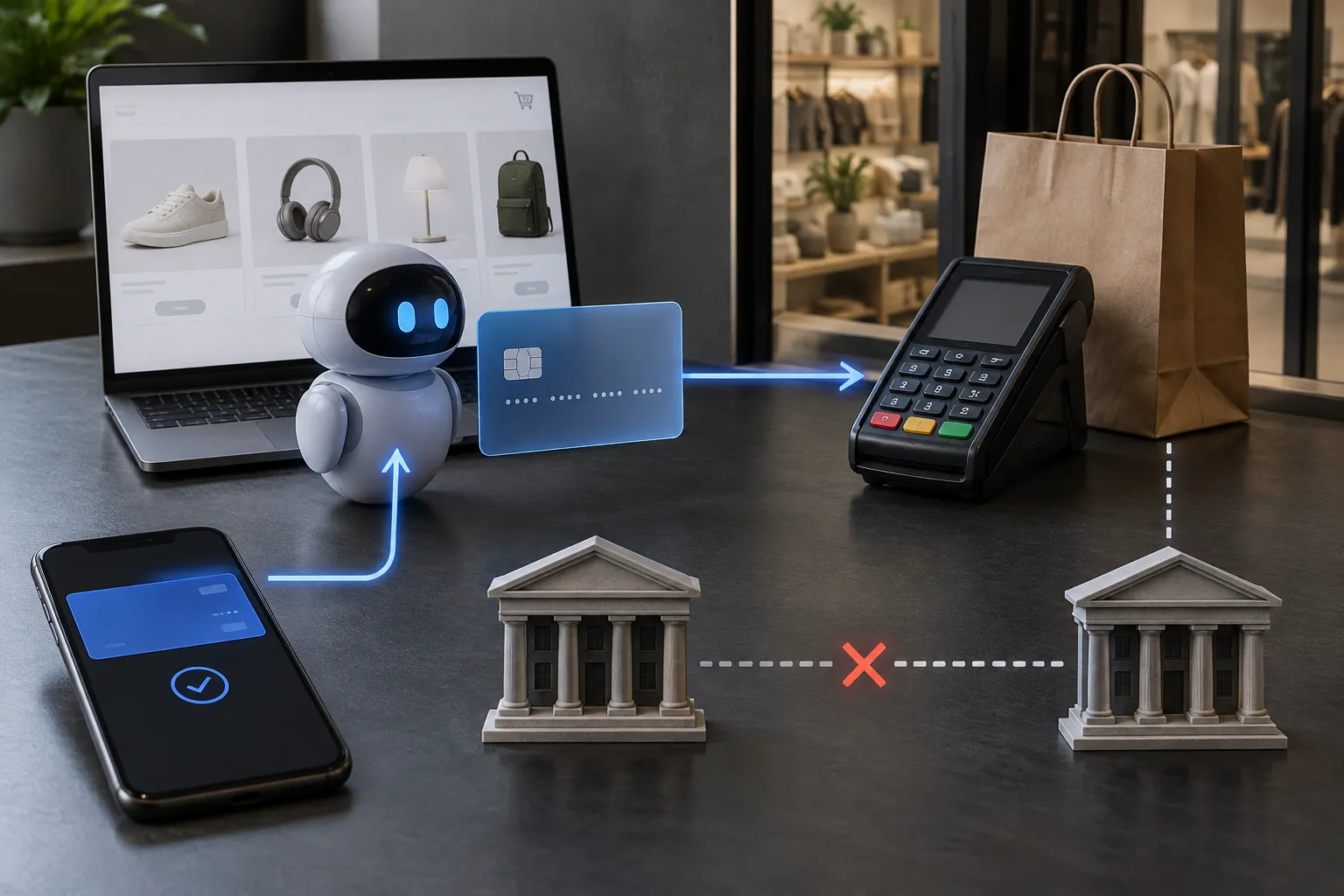
Stripe’s growing role in AI-assisted shopping has raised concerns at Visa and Mastercard about how payments are routed and what information reaches banks and card networks. At merchants outside Stripe’s checkout network, its Link wallet can give an AI agent a capped virtual card to complete a purchase, then charge the shopper’s saved payment method separately. That structure can leave the shopper’s issuing bank without a direct view of the merchant.
The distinction matters as shopping gains traction inside Meta’s Muse agent and Stripe reports sharp growth in agentic checkout volume. Stripe says it developed the virtual-card feature in consultation with network partners. Visa and Mastercard are advancing a different approach, using tokenized credentials linked to an existing card and controls designed to verify agents and spending permissions. Mastercard says multiple methods may coexist, while banks have called for auditable credentials that preserve the connection between consumers and merchants.
Stripe’s early lead in AI-assisted shopping has drawn scrutiny from Visa and Mastercard over a checkout method that can split a purchase into two separate card transactions. According to reporting cited in the research package, the card networks are concerned that Stripe’s virtual-card approach can obscure the merchant from a shopper’s issuing bank and shift payment routing and fee volume.
The dispute concerns who can see and control a transaction when an AI agent buys something for a customer. Stripe’s system helps agents complete purchases at storefronts that do not support its native Link checkout. The networks are promoting tokenized credentials tied to the customer’s existing card, preserving a more direct connection between the shopper, merchant and payment authorization.
Where Stripe Uses Virtual Cards
Meta launched its Muse personal AI agent in September 2026 with Stripe’s Link wallet integrated for browsing and checkout. The virtual-card mechanism is a fallback for merchants outside Stripe’s network, not the standard route for every Muse purchase. At more than 1 million businesses accepting Stripe Link, Muse can check out natively using Link Pay Tokens without generating a virtual card number, according to Stripe.
At other storefronts, Stripe Issuing can generate a temporary virtual card with a spending cap for the agent to use at the merchant. The merchant charges that card; Stripe separately charges the shopper’s primary payment method stored in Link. Although the two charges relate to one purchase, they appear as distinct transactions on payment rails.
That separation changes what each participant sees. The merchant’s acquirer does not receive the shopper’s actual card credentials. On the other side, the shopper’s issuing bank sees a charge from Stripe rather than a direct transaction with the downstream merchant. According to the reported concerns, that can limit the bank’s access to merchant information used in risk assessment and complicate the audit trail for fraud reviews or disputes.
The virtual card can also travel over a different card network from the shopper’s underlying card. That gives the checkout provider a way to influence routing—and potentially which network receives the associated transaction volume.
Networks Back Card-Linked Credentials
Visa Intelligent Commerce and Mastercard Agent Pay take a different approach. Their systems use payment tokens—substitute credentials for an existing card—alongside measures intended to verify an agent and define what it is permitted to spend. Visa’s Trusted Agent Protocol is one such verification layer. The network-backed designs aim to keep autonomous purchases connected to the cardholder’s established payment credential rather than create two disconnected card transactions.
The distinction is not simply whether a card number is protected. Both models can avoid exposing a shopper’s original card credentials to a merchant. The point of contention is whether the issuing bank and network retain a clear view of the merchant and the permissions behind an agent’s purchase.
Stripe has said it engineered its virtual-card checkout feature in consultation with network partners and expects it to align with developing industry standards. Sources close to Visa and Mastercard, cited in the reporting, contend that the proxy structure disrupts network visibility and established fraud and dispute processes. Mastercard has publicly said different agent-payment methods may coexist as the market develops, while expecting tokenized credentials to prevail over time. Visa declined to comment on Stripe’s virtual-card model.
Mastercard is also extending its framework beyond shopping. In October, it opened early access to Agent Pay for Machines, designed for frequent autonomous micro-transactions and machine payments using the x402 open protocol.
Shopping Growth Raises the Stakes
The disagreement comes as agent-led purchasing moves beyond demonstrations. Meta Chief Executive Mark Zuckerberg said on an October earnings call that shopping was Muse’s leading use case. More than 25% of its 10 million users were shopping within the app, he said, with an average purchase size above $200. Meta and Stripe raised credit limits in response.
Stripe reported that agentic checkout volume processed through Link grew 38-fold in September following rollouts across Muse, xAI’s Grok Bot and Instinct. That figure is Stripe’s reported growth rate, not a measure of the overall agentic-commerce market. Shopify also integrated Shop Pay into Muse in September, ending Link’s exclusive wallet position in the agent.
Banks are weighing the risks as these payment methods expand. Bank of America and five other international banks issued joint guidance advising against mechanisms that break the direct link between consumer and merchant identity. They advocated auditable credentials instead. For checkout providers, networks and banks, the unresolved question is how to let agents transact across storefronts while preserving the information needed to authorize payments, assess risk and resolve disputes.

Banks have moved AI into core risk and treasury work faster than they have established controls to oversee it, according to research published by SAS, FT Longitude and Microsoft on October 22, 2026. The survey of 300 risk, credit and treasury decision-makers across 31 countries found that 59% of responding banks had moved beyond early experimentation. AI was partially or widely embedded in 63% of core credit risk workflows and 55% of asset-liability management and balance-sheet risk steering processes. Governance has not kept pace. Only 19% of surveyed institutions reported real-time monitoring for model drift, while 42% lacked documented, operational kill switches for autonomous models. Another 26% had no dedicated AI model risk policy. Although 76% expect AI to make autonomous credit and risk decisions at scale by 2031, only 10% say it does so today. The findings distinguish widespread AI use from the more demanding task of supervising autonomous decisions.
Stripe’s growing role in AI-assisted shopping has raised concerns at Visa and Mastercard about how payments are routed and what information reaches banks and card networks. At merchants outside Stripe’s checkout network, its Link wallet can give an AI agent a capped virtual card to complete a purchase, then charge the shopper’s saved payment method separately. That structure can leave the shopper’s issuing bank without a direct view of the merchant. The distinction matters as shopping gains traction inside Meta’s Muse agent and Stripe reports sharp growth in agentic checkout volume. Stripe says it developed the virtual-card feature in consultation with network partners. Visa and Mastercard are advancing a different approach, using tokenized credentials linked to an existing card and controls designed to verify agents and spending permissions. Mastercard says multiple methods may coexist, while banks have called for auditable credentials that preserve the connection between consumers and merchants.
Visa’s Agentic Commerce Benchmark found that 22 AI models made suitable shopping decisions in 57.2% of test runs, leaving a 42.8% failure rate. The assessment tested whether agents could identify products that met a buyer’s requirements—or decline to buy when none did. Models that gathered more buyer details through conversation performed better, but even the strongest model fell short of a perfect score. The findings concern shopping decisions, not a direct test of payment execution. The results add to questions about how autonomous purchasing could operate at scale. Visa’s consumer research found limited trust in AI systems making payments, while its survey of acquirers identified liability and compliance concerns. Disputed agent transactions currently fall under existing card-not-present rules unless an authenticated, tokenized flow shifts liability. Payment-industry work on agent identity and standards is advancing, but a unified approach to disputes over non-fraud purchases by autonomous agents has not been established.

Mastercard is seeking to make network tokens the payment standard for purchases initiated by AI agents. On its October 29, 2026, earnings call, Chief Executive Michael Miebach described processor-issued one-time virtual card numbers as a temporary bridge rather than a lasting approach. He said Mastercard would support end-to-end tokenization through Agent Pay to preserve cardholder choice, rewards and spending controls. The company also announced that Shopify is integrating Agent Pay and network tokens into Shop Pay, alongside a strategic partnership with OpenAI covering AI payments and services. Mastercard has been building merchant-facing tools for agentic commerce throughout 2026, but Miebach acknowledged that merchants’ technical readiness remains uneven. Other payments companies are developing their own approaches: Stripe supports agentic network tokens from Mastercard and Visa, while Visa has introduced tools for AI-driven shopping. Consumer concerns about fraud and liability remain a potential barrier to adoption.

The Linux Foundation appointed payments veteran Michael Hursta executive director of the x402 Foundation on October 1, 2026, as payment systems designed for autonomous AI agents gained attention. Foundation members reported more than 75 million agentic payment transactions in a 30-day period in September, and Coinbase and Amazon Web Services showcased production payment rails at Sibos 2026. Reported transaction counts, however, do not establish the value or commercial character of that activity. The emerging protocols address different obstacles. Coinbase’s x402 enables per-request USDC payments through HTTP, while Google’s Agent Payments Protocol uses signed mandates to connect an agent’s purchases to a user’s authorization. Stripe and Tempo have also proposed session-based billing through the Machine Payments Protocol. These approaches respond to card fees and interactive checkout checks that can impede small, automated transactions. Card networks are developing delegated-identity tools, leaving multiple potential paths for agent payments rather than a single replacement for existing rails.
Mastercard opened developer early access for Agent Pay for Machines (AP4M) on October 20, 2026, releasing buyer- and seller-side APIs, a sandbox and developer toolkits. In a Cloudflare Connect demonstration, marketing agency Hype tested an autonomous agent making nine payments to two merchants within a single budget, without manual billing or account setup. AP4M uses HTTP 402 payment challenges, but differs from crypto-native implementations of the x402 protocol. Its agents issue digitally signed vouchers off-chain; merchants can batch and redeem them later instead of settling every request on-chain. The pilot combined agent wallet infrastructure from Coinbase Developer Platform and BVNK, settlement on Base, and Mastercard’s multi-currency fiat and stablecoin settlement platform. Circle separately expanded its managed payments service to target AI-agent traffic using USDC. Together, the developments show competing approaches to machine-to-machine payments, with different choices about settlement, funding and who manages digital assets.